Shibing Mo (莫世冰)

I am a second-year Ph.D. student in the School of Artificial Intelligence at Xidian University, advised by Prof. Jing Liu.

My current research interests include automated algorithm design, model post-training, agents, and AI for EDA. I am interested in building practical AI-driven methods that can improve design automation workflows and make algorithm development more efficient.

I am actively seeking relevant internship opportunities.

Shibing Mo profile photo

Current Work

Publications

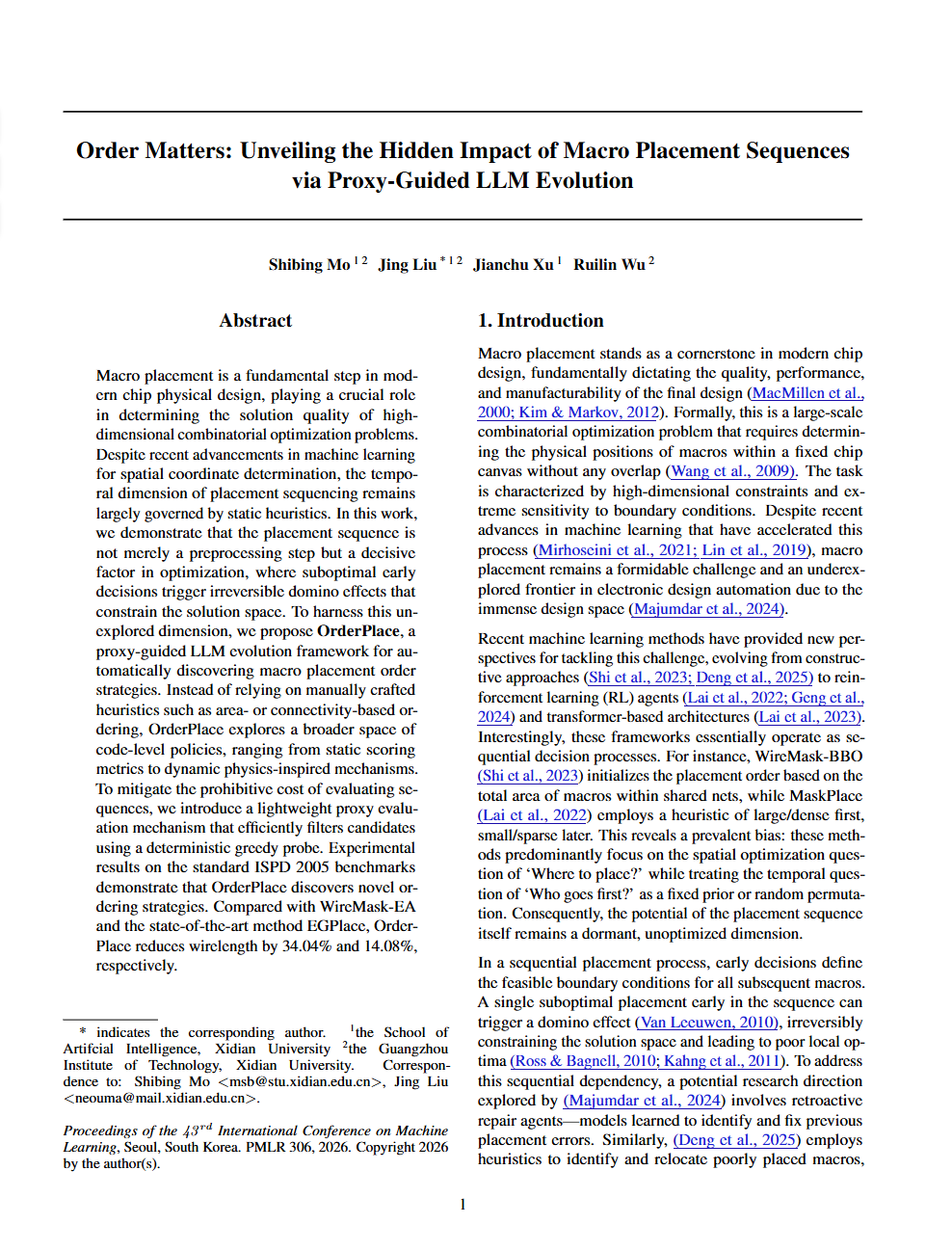
Order Matters overview

Order Matters: Unveiling the Hidden Impact of Macro Placement Sequences via Proxy-Guided LLM Evolution

Shibing Mo, Jing Liu, Jianchu Xu, Ruilin Wu.

International Conference on Machine Learning (ICML), 2026. CCF-A

TL;DR: Uses proxy-guided LLM evolution to discover macro placement ordering strategies that reduce wirelength in chip physical design.
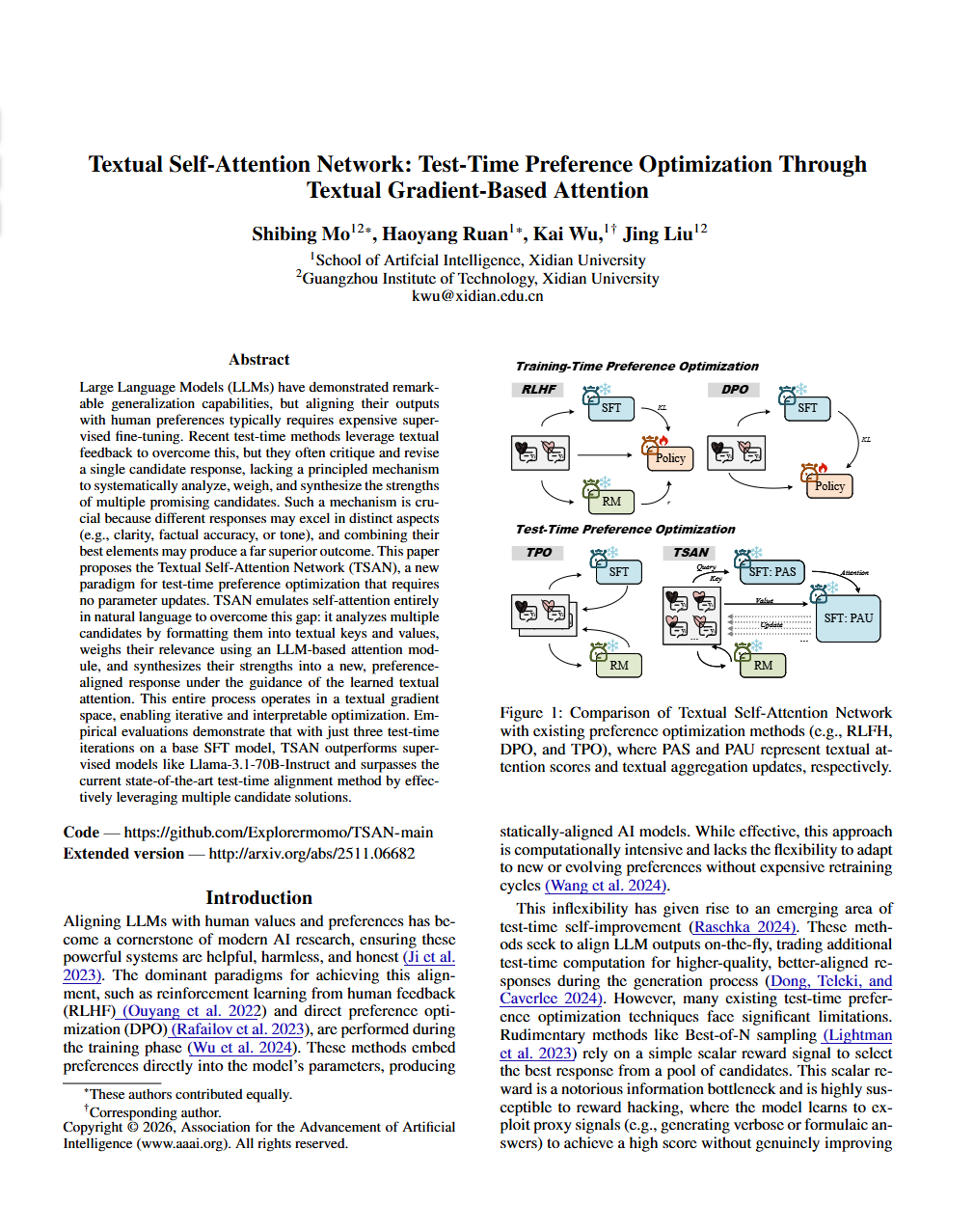
Textual Self-Attention Network overview

Textual Self-Attention Network: Test-Time Preference Optimization Through Textual Gradient-Based Attention

Shibing Mo, Haoyang Ruan, Kai Wu, Jing Liu.

AAAI Conference on Artificial Intelligence (AAAI), 2026. CCF-A

TL;DR: Performs test-time preference optimization by modeling candidate responses as textual keys and values in an LLM-based self-attention process.

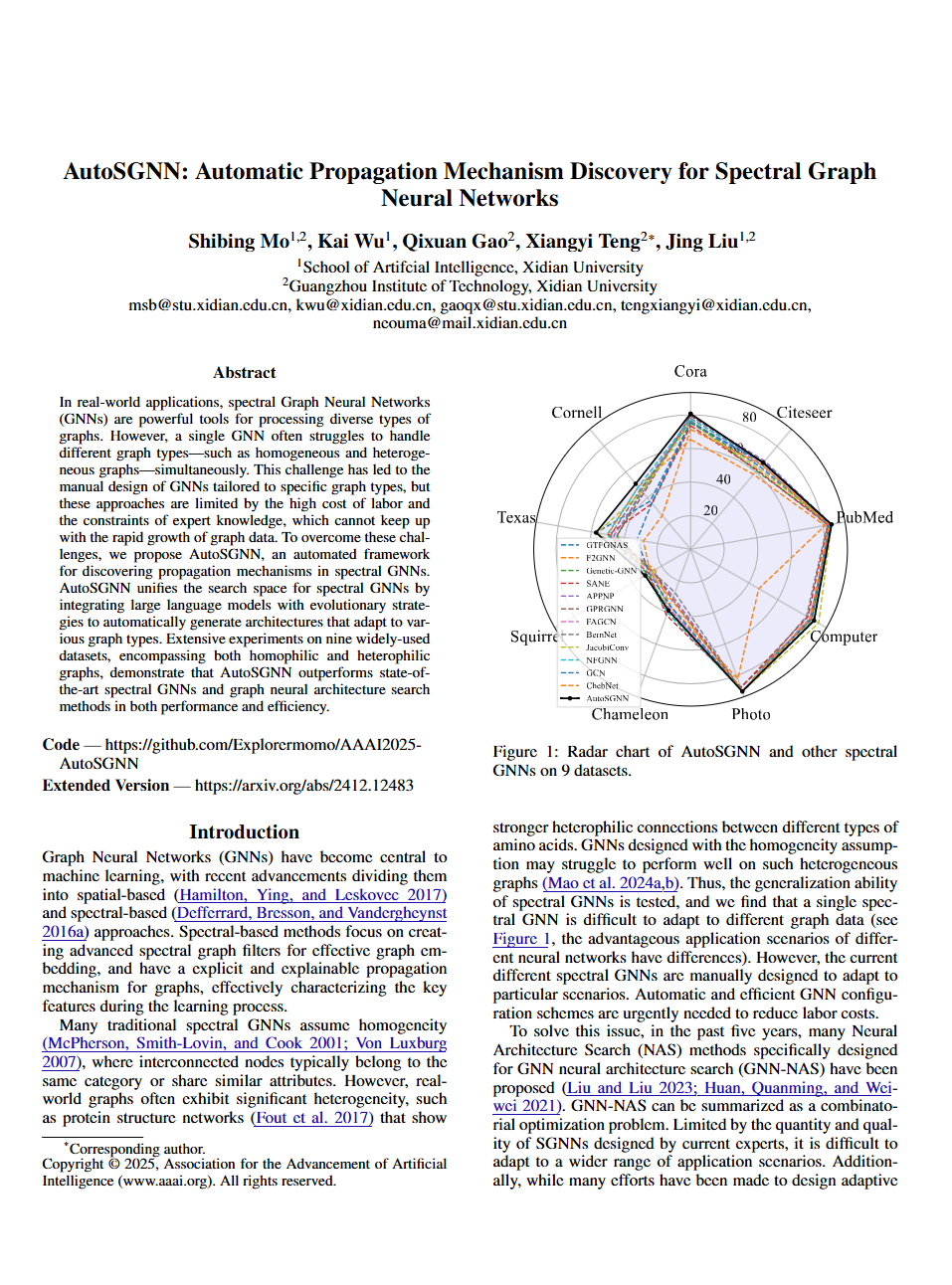
AutoSGNN overview

AutoSGNN: Automatic Propagation Mechanism Discovery for Spectral Graph Neural Networks

Shibing Mo, Kai Wu, Qixuan Gao, Xiangyi Teng, Jing Liu.

AAAI Conference on Artificial Intelligence (AAAI), 2025. CCF-A

TL;DR: Automatically searches spectral GNN propagation mechanisms with LLM-guided evolutionary design across homophilic and heterophilic graphs.

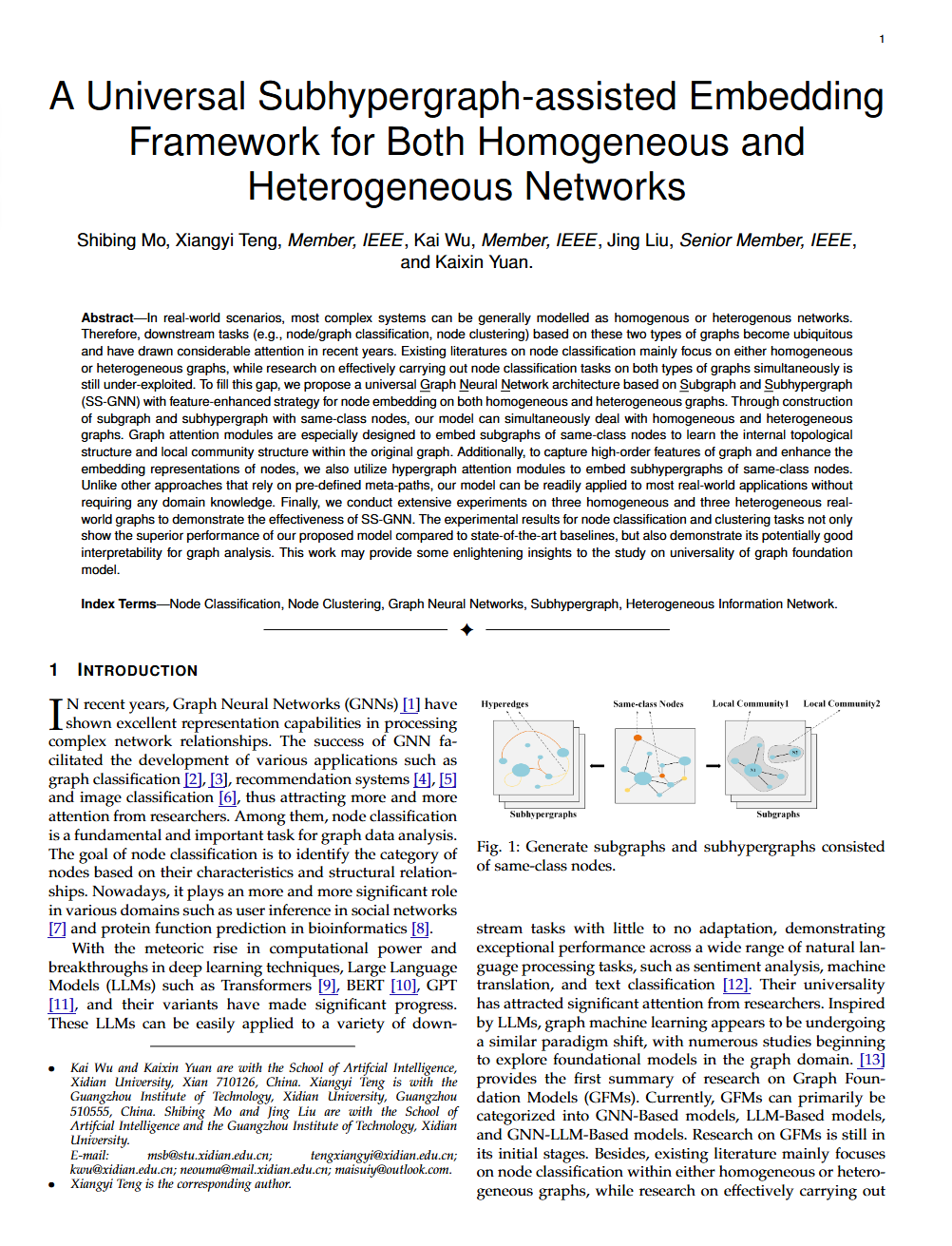
Subhypergraph-assisted embedding overview

A Universal Subhypergraph-assisted Embedding Framework for Both Homogeneous and Heterogeneous Networks

Shibing Mo, Xiangyi Teng, Kai Wu, Jing Liu, Kaixin Yuan.

IEEE Transactions on Knowledge and Data Engineering (TKDE), 2025. SCI-Q1, CCF-A

TL;DR: Introduces subgraph and subhypergraph-assisted embeddings to unify node representation learning for homogeneous and heterogeneous networks.

AutoMOAE overview

AutoMOAE: Multi-Objective Auto-Algorithm Evolution

Shibing Mo, Yudong Yang, Kai Wu, Handing Wang.

IEEE Transactions on Evolutionary Computation (TEVC), 2026. SCI-Q1

TL;DR: Automates multi-objective algorithm design by evolving LLM-generated operators under quality and efficiency constraints.

High-order Knowledge overview

High-order Knowledge Based Network Controllability Robustness Prediction: A Hypergraph Neural Network Approach

Shibing Mo, Jiarui Zhang, Jiayu Xie, Xiangyi Teng, Jing Liu.

IEEE Transactions on Network Science and Engineering (TNSE), 2026. SCI-Q2

TL;DR: Predicts network controllability robustness by learning high-order structural knowledge with dual hypergraph attention.

Bias-corrected multi-scale spatiotemporal networks overview

Bias-corrected Multi-scale Spatiotemporal Networks for Multivariate Time Series Imputation

Shibing Mo, Haoyang Ruan, Kaixin Yuan, Xiangyi Teng, Jing Liu.

Neurocomputing, 2026. SCI-Q2

TL;DR: Improves multivariate time-series imputation with bias-corrected graph learning and multi-scale temporal dynamics.

Preprints

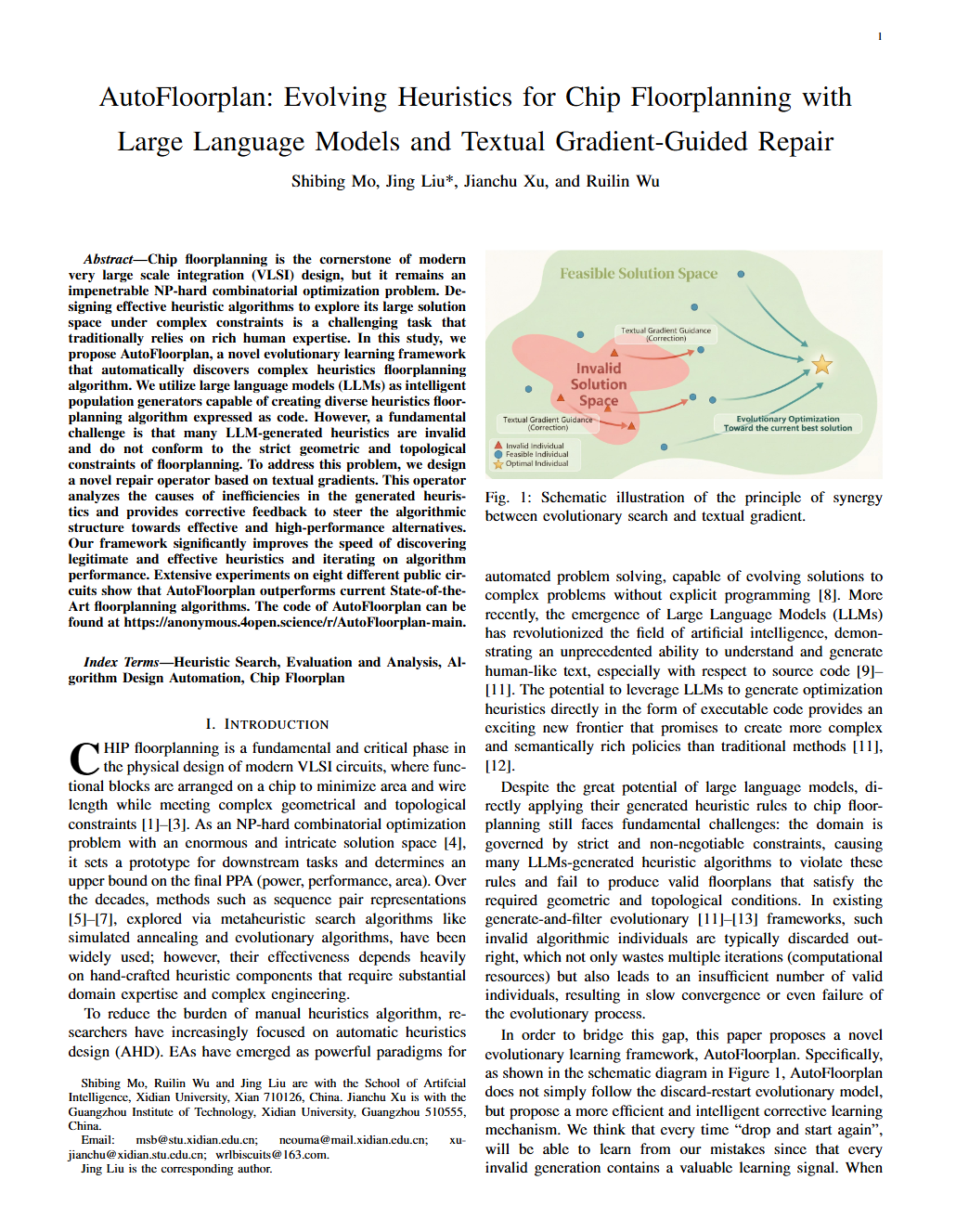
AutoFloorplan overview

AutoFloorplan: Evolving Heuristics for Chip Floorplanning with Large Language Models and Textual Gradient-Guided Repair

Shibing Mo, Jing Liu, Jianchu Xu, Ruilin Wu.

Preprint, 2026.

TL;DR: Evolves chip floorplanning heuristics with LLM-generated code and repairs invalid candidates through textual gradient feedback.

EAPlace-VLM overview

EAPlace-VLM: Escaping Local Optima in Macro Placement via VLM-Guided Relocation and Continuous Physical Refinement

Jianchu Xu*, Shibing Mo*, Jing Liu, Ruilin Wu.

Preprint, 2026.

TL;DR: Combines VLM-guided relocation with continuous physical refinement to escape local optima in macro placement.

Unified Feature Mapping overview

Unified Feature Mapping for Graph Representation Learning

Haoyang Ruan*, Shibing Mo*, Kai Wu.

Preprint, 2026.

TL;DR: Maps heterogeneous graph features into a unified latent space to support cross-domain graph representation learning.